

ESG Tools

Over the past five years, Jon Key and Helen Mitchell have worked with the World Jewellery Confederation (CIBJO) to develop a practical, integrated suite of environmental, social and governance (ESG) tools for the jewellery industry. The three resources below — the ESG Wheel, the Double Materiality Assessment Guide, and the ESG Measurement Guidelines — work together to help businesses of all sizes understand, prioritise and measure their sustainability impact across the value chain.
They are designed to be accessible to small and medium-sized businesses (SMEs), who make up the vast majority of the jewellery industry, while remaining rigorous enough for larger organisations. All three are freely available below.

How the Three Tools Work Together
The three tools form an integrated ESG journey:
The ESG Wheel establishes the 14 principles — where to focus.
The DMA Guide helps you identify which of those principles matter most to your business — what to prioritise.
The Measurement Guidelines provide the KPIs and metrics to track progress on your priorities — how to measure.
Together, they take a jewellery business from understanding ESG to acting on it credibly — without the complexity that typically deters smaller organisations.

The ESG Wheel — Principles for Jewellery Sustainability
Published 2023 · Co-developed by Key & Co with the CIBJO Laboratory-Grown Diamond Committee
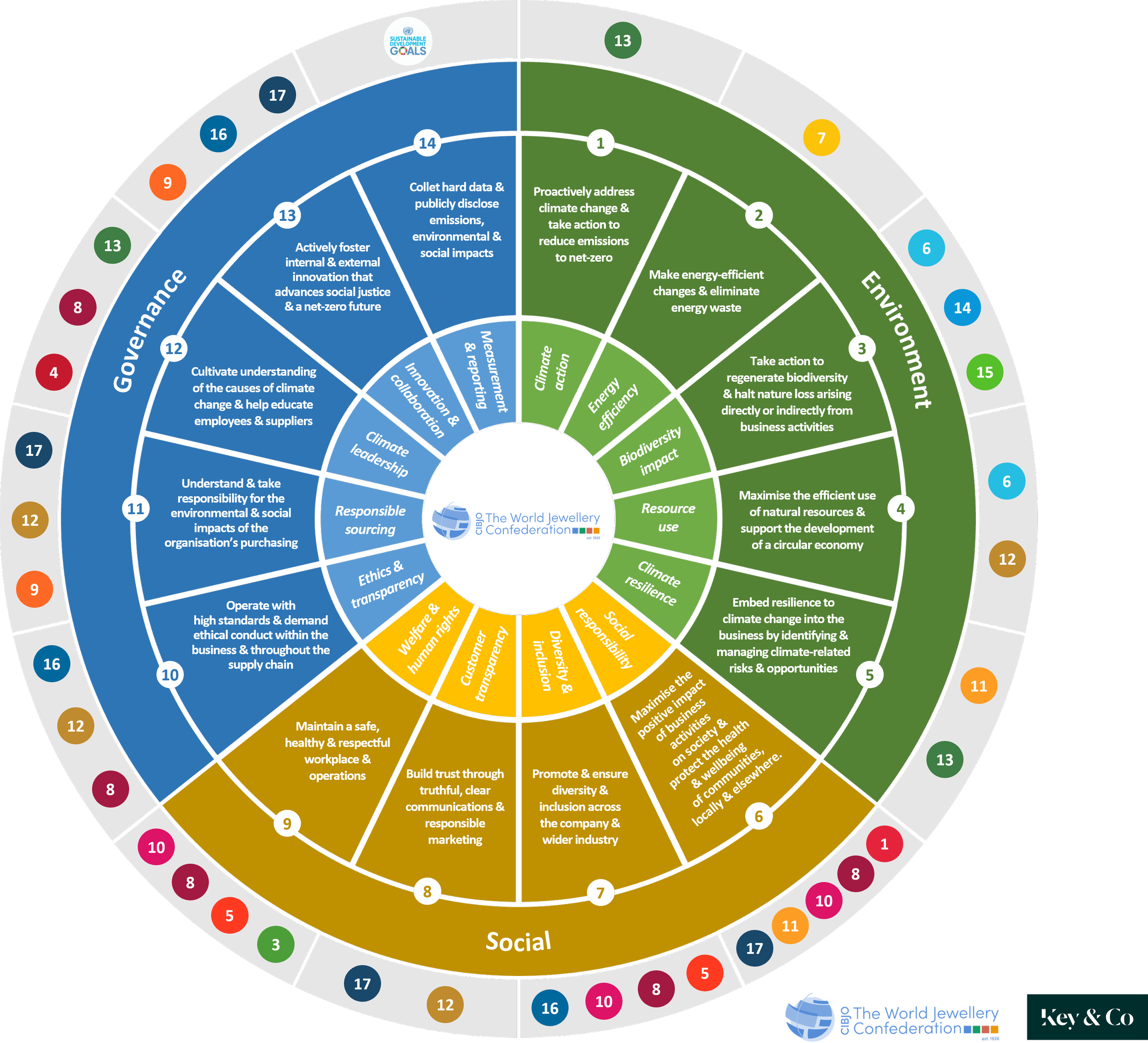
The ESG Wheel is a practical framework of 14 sustainability principles structured across environmental, social and governance themes. Originally developed for the laboratory-grown diamond sector and now applied across the wider jewellery industry, the Wheel provides an accessible starting point for businesses thinking about ESG — particularly small and medium-sized enterprises.
The 14 principles span topics including climate action, energy efficiency, biodiversity, resource use, social responsibility, diversity and inclusion, ethics and transparency, responsible sourcing, and climate leadership. Each principle includes a clear statement, examples of recommended actions, and alignment with the United Nations Sustainable Development Goals.
Use the Wheel as the foundation for identifying which sustainability topics matter most to your business — the starting point for a double materiality assessment and the framework against which ESG performance can be measured and reported.
Double Materiality Assessment Guide for the Jewellery Sector
Presented 2025 · Co-developed by Key & Co with CIBJO · SME focus
A double materiality assessment (DMA) is the cornerstone of credible ESG strategy and a regulatory requirement under the EU Corporate Sustainability Reporting Directive (CSRD). It identifies the sustainability topics that have the greatest impact on stakeholders and the greatest impact on financial performance — the topics that genuinely matter and should drive strategic focus.
This guide provides a practical, step-by-step methodology specifically designed for jewellery sector SMEs, with worked examples from diamond polishing, gold retail and coloured stones. It covers:
A clear definition of double materiality and how it differs from traditional approaches
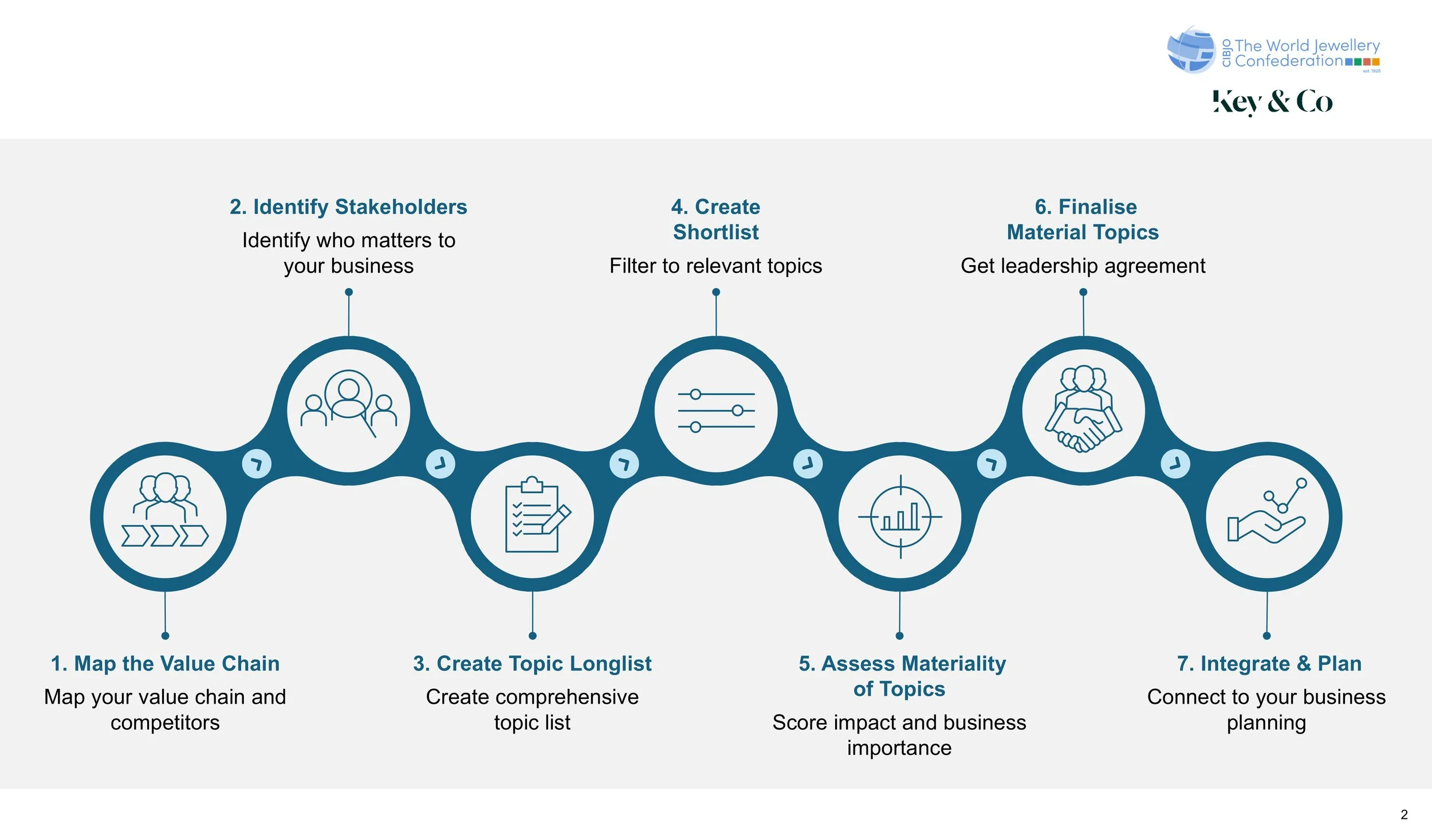
A 7-step process from value chain mapping to integrated action planning
Differentiated guidance for organisations of all sizes — from micro-businesses (2-hour quick start) to large enterprises
Connection to the ESG Wheel (for topic generation) and the ESG Measurement Guidelines (for tracking progress)
Companion materials: a Visual Guide for workshops and an Excel Assessment Toolkit
Use the DMA Guide to prioritise which of the ESG Wheel's 14 themes matter most to your specific operations, stakeholders and value chain — and translate that into focused, actionable strategy.
ESG Measurement Guidelines
Published January 2025 · Co-developed by Key & Co with the CIBJO Sustainable Development Commission
You cannot manage what you do not measure. The ESG Measurement Guidelines translate the 14 themes of the ESG Wheel into a structured set of key performance indicators (KPIs) and measurement areas, giving jewellery businesses a credible basis for tracking ESG progress in a way that is consistent, comparable and proportionate to their size and maturity.
The Guidelines cover:
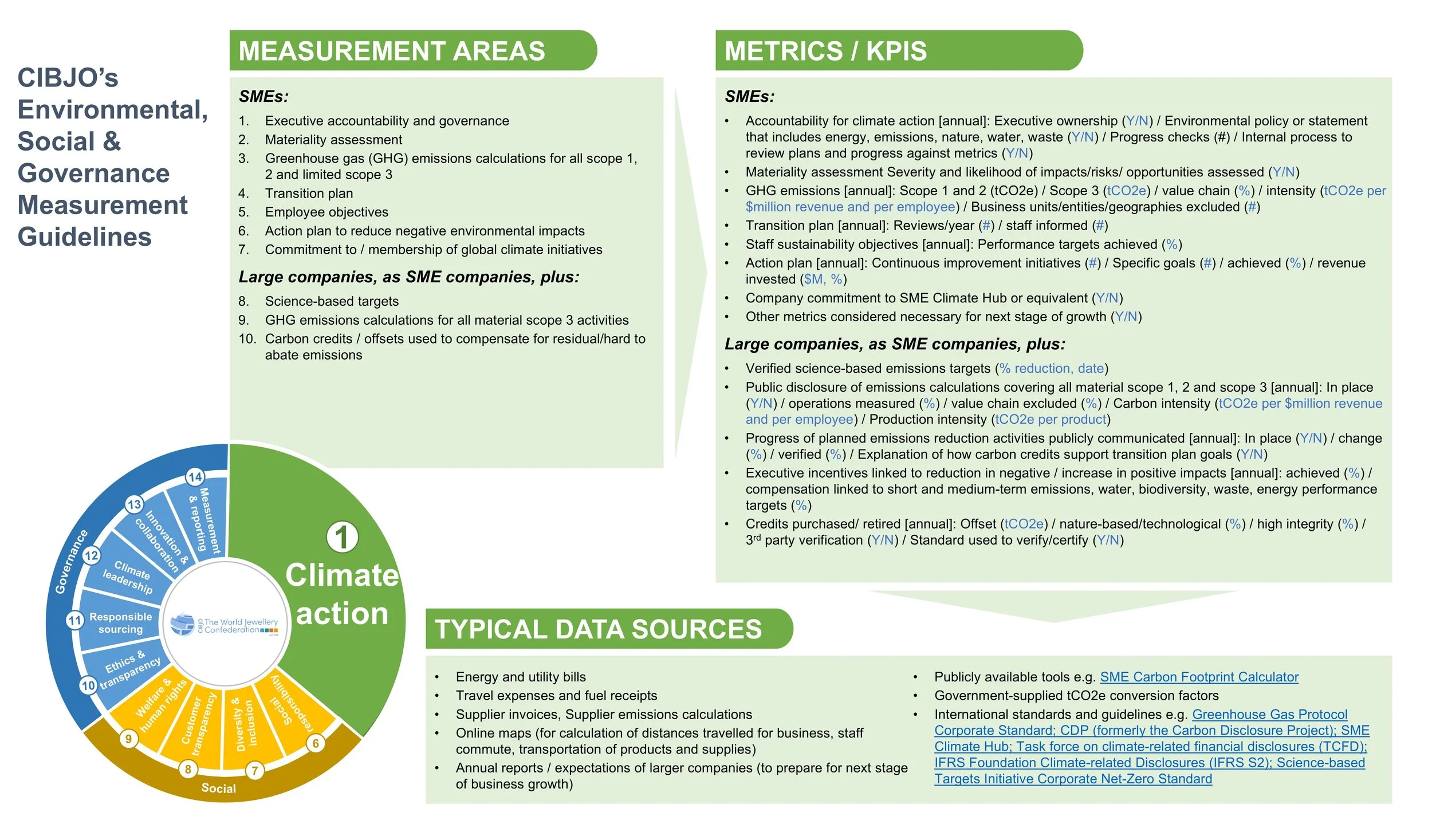
All 14 ESG themes with specific measurement areas and example metrics for each
Differentiated guidance for SMEs (focused subset) and large companies (full scope, 16+ topics)
A 10-step practical implementation process — from naming a measurement owner to publishing your first impact report
Alignment with international standards including GRI, ISSB, TCFD, ESRS and OECD Guidelines
A glossary of ESG terminology and signposts to further support
Use the Measurement Guidelines to track progress on the material topics identified through your DMA, set credible targets, and report transparently to customers, investors, regulators and other stakeholders.
Looking for ESG strategy support tailored to your business?
Key & Co partners with businesses of all sizes to develop and implement ESG strategy. From foundational principles to materiality assessment, measurement and reporting — get in touch to discuss your needs.